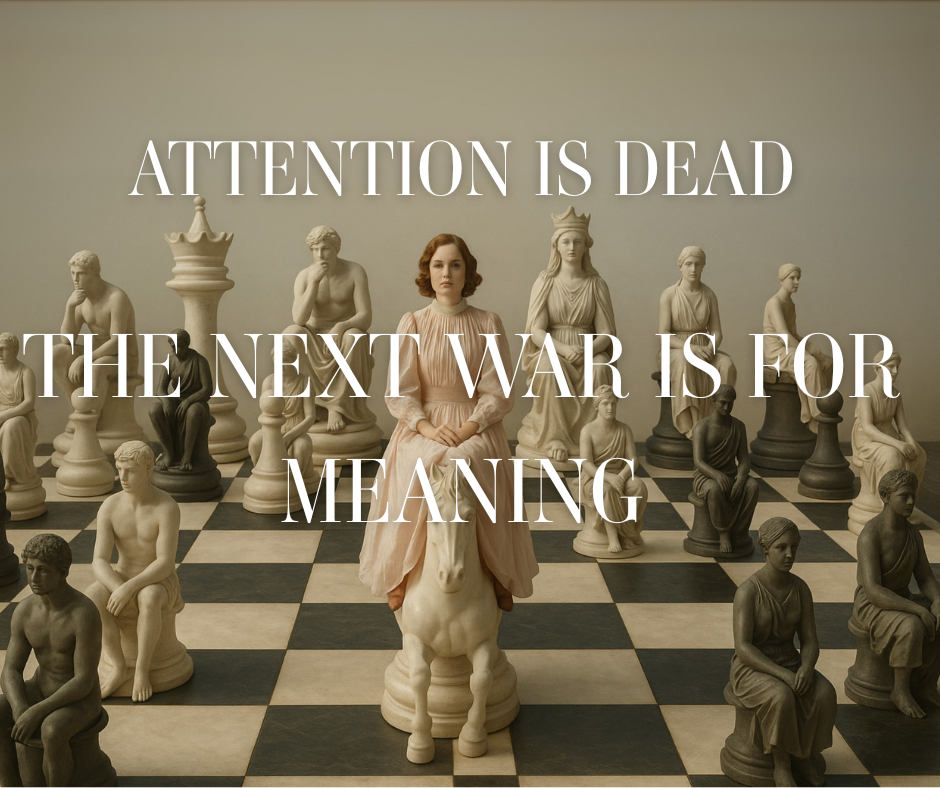
For over a decade, the marketing industry has relied on a singular dogma: that attention is the highest currency a brand can earn. Metrics like impressions, reach, click-through rates, and engagement have dominated campaign reports and shaped the architecture of digital strategy. Attention became not just the objective, but the justification for creativity, for storytelling, even for the brand’s very existence.
But attention, like all currencies, is subject to devaluation.
And it is currently in freefall.
We are not witnessing a shortage of content, but a collapse of consequence. People are not consuming less; they are simply remembering less, feeling less, caring less. This isn’t apathy. It’s saturation. It is the inevitable decline of a culture engineered for infinite stimulation, a culture in which everything is loud, and thus nothing is heard.
In this context, the pursuit of attention has become a hollow exercise. It is possible today to gain massive visibility and leave behind no emotional residue, no shift in perspective, no aftertaste. Brands now flood timelines without ever entering consciousness. And herein lies the strategic reckoning: attention may be captured, but meaning must be earned.
The Saturation Threshold: When Attention Becomes Meaningless
The modern consumer does not suffer from a lack of content but from an excess of low-density signals. We are presented with infinite scrolls, algorithmically generated aesthetic sameness, and a relentless demand for reaction. Over time, this has created what could be described as a cognitive immunity, a numbness to information that doesn’t move beyond the surface.
From a neurocognitive standpoint, the brain cannot sustainably register thousands of discrete, emotionally shallow inputs per day. We are reaching what I define as the Saturation Threshold, the point at which more attention simply leads to less retention.
What does this mean for brands?
It means that content, no matter how beautifully packaged is increasingly unable to generate depth. Visibility alone is not an influence. The capacity to momentarily interrupt a scroll does not imply the ability to reshape perception. Brands are being seen, but they are not being integrated into memory or identity. They’re flickers, not fixtures.
The End of Metrics as Meaning
Marketers have long relied on quantitative data to measure success. And in some contexts, these indicators remain useful. But in a post-attention economy, the central KPIs begin to fail as proxies for actual impact. An impression is simply evidence that a user’s screen showed your asset. Engagement is often incentivized by novelty or outrage not emotional alignment. Reach is not resonance.
In many cases, brands are now optimising for noise instead of depth, and the result is performance without imprint. We’ve built systems that prioritise stimulus over significance. But stimulus is no longer scarce. Meaning is.
The shift that’s emerging is not just strategic, it’s philosophical. The future of brand power will be defined not by how many people saw something, but by how deeply it changed those who did.
“Brush up on colors and their associated emotions to make sure you nail the mood and tone of your brand.”
The Architecture of Meaning
Meaning, unlike attention, is a long-game phenomenon. It is not produced by virality but by interiority, the quiet work a brand does inside the mind of its audience. It is the shift in someone’s internal language after encountering your idea. It is the change in how they describe themselves, even if they never mention your name. Meaning leaves no traceable UTM code, but it restructures the worldview.
This is where the industry must evolve. We must move from building marketing assets to building meaning systems, integrated, semiotically rich ecosystems where every visual, every word, every behaviour is part of a coherent, intelligent worldview. Brands must stop mimicking culture and start authoring it.
This will require a new creative class: less obsessed with aesthetics and more fluent in philosophy, politics, art history, memory, and myth. We don’t need another campaign. We need a cultural thesis. A why that feels like an origin myth.
To survive the coming shift, brands must become memes of meaning culturally transmissible containers of ideology, belief, and emotional structure. They must design for memory, not merely interaction. They must speak less frequently but with more gravity. They must stop being performers of trends and become creators of internal disruption.
The next iconic brands will not go viral because of an ad. They will be remembered because they introduced a new way of seeing the self. They will be whispered in private conversations, cited in academic texts, and mimicked by those still too afraid to fully understand them.
They will not ask for attention.
They will demand interpretation
Toward a New Brand Ethic
The next evolution in marketing is not about performance. It’s about possession. The ability of a brand to occupy mental real estate not by force, but by significance. Not because it asked to be remembered, but because it became psychologically and culturally unavoidable.
We must now ask more difficult questions:
• Does your brand produce language, or just noise?
• Does it offer identity, or simply imagery?
• Does it collapse after the scroll, or does it haunt the space between thought and speech?
These are not creative questions.
They are ethical ones.
Because chasing attention in a world collapsing under its weight is not just a poor strategy, it is intellectual laziness.
What’s Next?
In the era to come, the most valuable brands will not be the most visible, the most followed, or even the most loved.
They will be the most interpreted.
They will invite analysis.
They will withstand scrutiny.
They will be studied, not just scrolled.
Because meaning is what survives.
Meaning is what spreads.
And meaning, unlike attention, does not fade.
It accumulates.
And if your brand cannot accumulate meaning it will disappear.
Not with a scandal. Not with a crash.
But with silence.
And the world will simply move on.


What do you think?
It’s a modern look and suits up-and-coming brands that offer a unique product or service.